Verify identity
MFA and identity-aware policy strengthen access decisions for supported applications and services.
 Start a conversation
 Healthcare security
Kenmie Computer provides technology and managed services that can help healthcare organizations protect electronic protected health information across users, devices, networks, facilities, cloud services, and communications.
Safeguards working together
Administrative processes, physical protections, and technical controls must operate together around electronic protected health information and the people responsible for it.
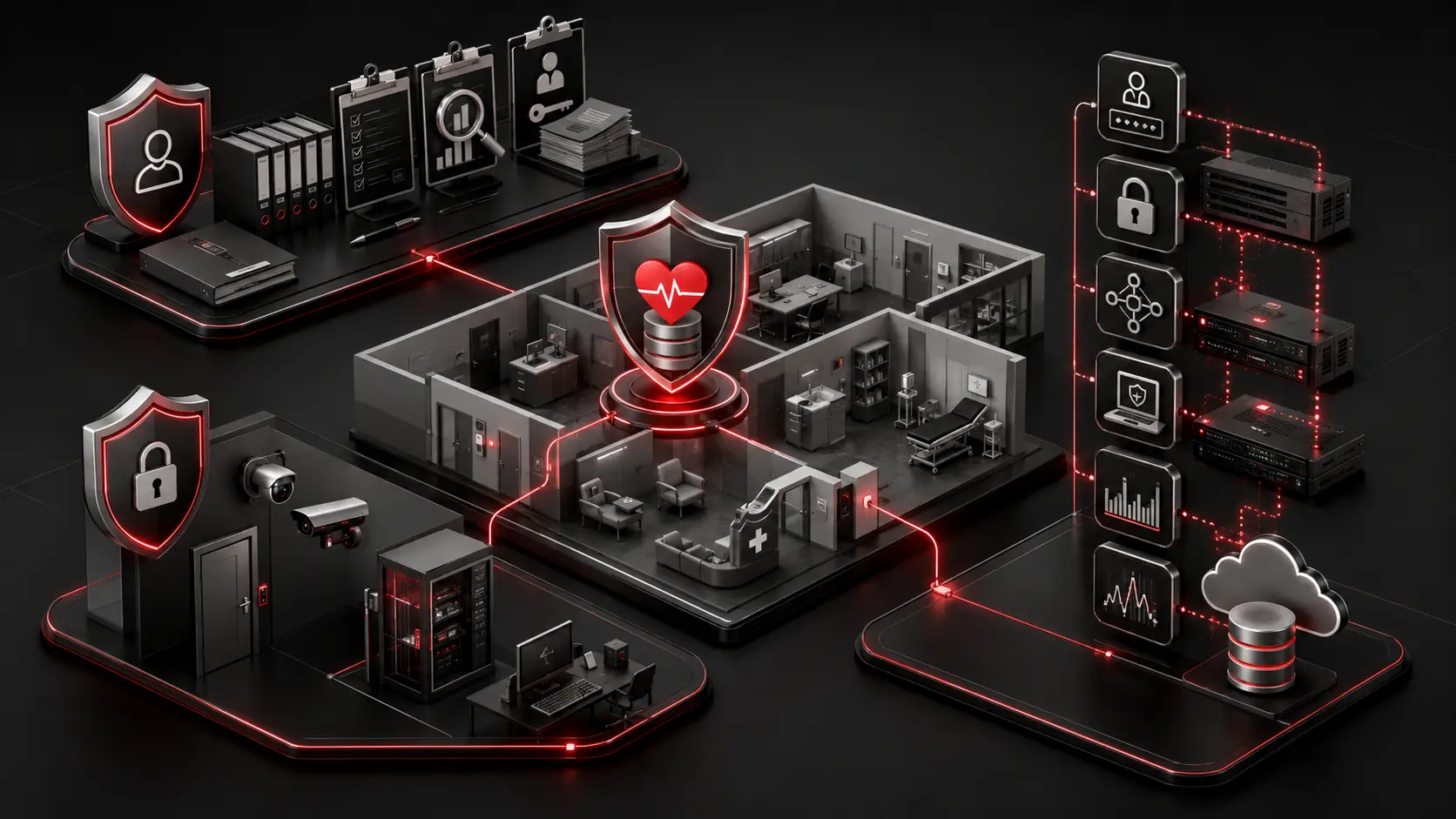
HIPAA compliance depends on the regulated organization’s documented risk analysis, policies, workforce practices, contracts, procedures, and implementation decisions. No individual product or service makes an organization HIPAA compliant.
Technology’s role
The appropriate controls are determined through the organization’s own risk analysis. Kenmie helps turn selected technical and physical safeguards into configured, monitored, and supported services.
MFA and identity-aware policy strengthen access decisions for supported applications and services.
Connected telemetry and managed investigation help turn security events into documented response.
Cloud backup and resilient infrastructure support recovery planning when systems or data become unavailable.
Encryption and protected connectivity help safeguard sensitive information during transmission.
Safeguard cross-reference
These mappings describe how Kenmie offerings can support safeguard objectives. They are not a substitute for a customer-specific legal, regulatory, or risk determination.
Policies and processes used to select, operate, review, and improve safeguards for electronic protected health information.
Technical inventory, monitoring, centralized visibility, and reporting can provide evidence for an organization’s ongoing risk-management process.
Continuous monitoring, expert investigation, endpoint response, and incident coordination can help detect, contain, and document security events.
Protected cloud backups and appropriately designed compute and storage infrastructure can support data recovery and operational continuity planning.
Controls that help protect facilities, workstations, equipment, and the physical environments where ePHI may be accessed.
Managed physical access systems can help restrict and document entry to offices, equipment rooms, and other controlled spaces.
Properly scoped video systems can support facility oversight and incident review when deployment, retention, and access policies are defined appropriately.
Business-class endpoints combined with endpoint protection, monitoring, and controlled patching can support secure workstation operations.
Technology controls that protect access to ePHI, preserve integrity, record activity, and secure data while it is transmitted.
Multi-factor authentication, identity-aware access, network segmentation, and least-privilege policies can help restrict access to authorized users and resources.
Centralized logging, security telemetry, cloud monitoring, and managed investigation can help organizations record and review system activity.
Endpoint protection, controlled patching, network defense, and recoverable backups can reduce known exposure and help preserve system and data integrity.
Encrypted email, secure remote access, VPN connectivity, protected wireless, and appropriately designed networks can help protect ePHI in transit.
AI application discovery, OAuth visibility, prompt-level inspection, and policy enforcement can help reduce the risk of workforce members disclosing ePHI through unapproved generative AI services.
Dedicated filtering can reduce spam, malware, impersonation, and other email-borne risks, while encryption separately protects sensitive message content.
Organizational responsibility
HIPAA extends beyond cybersecurity products. These responsibilities remain with the covered entity or business associate and its qualified legal, privacy, compliance, and operational advisors.
Authoritative guidance
HHS identifies risk analysis as foundational to Security Rule compliance. NIST SP 800-66 Rev. 2 provides a cybersecurity resource guide for applying the rule. HHS has also published proposed Security Rule changes, so requirements and guidance should be reviewed as they evolve.
Plan the technology safeguards
Kenmie can help scope, deploy, monitor, maintain, and support the technology selected for your healthcare environment.