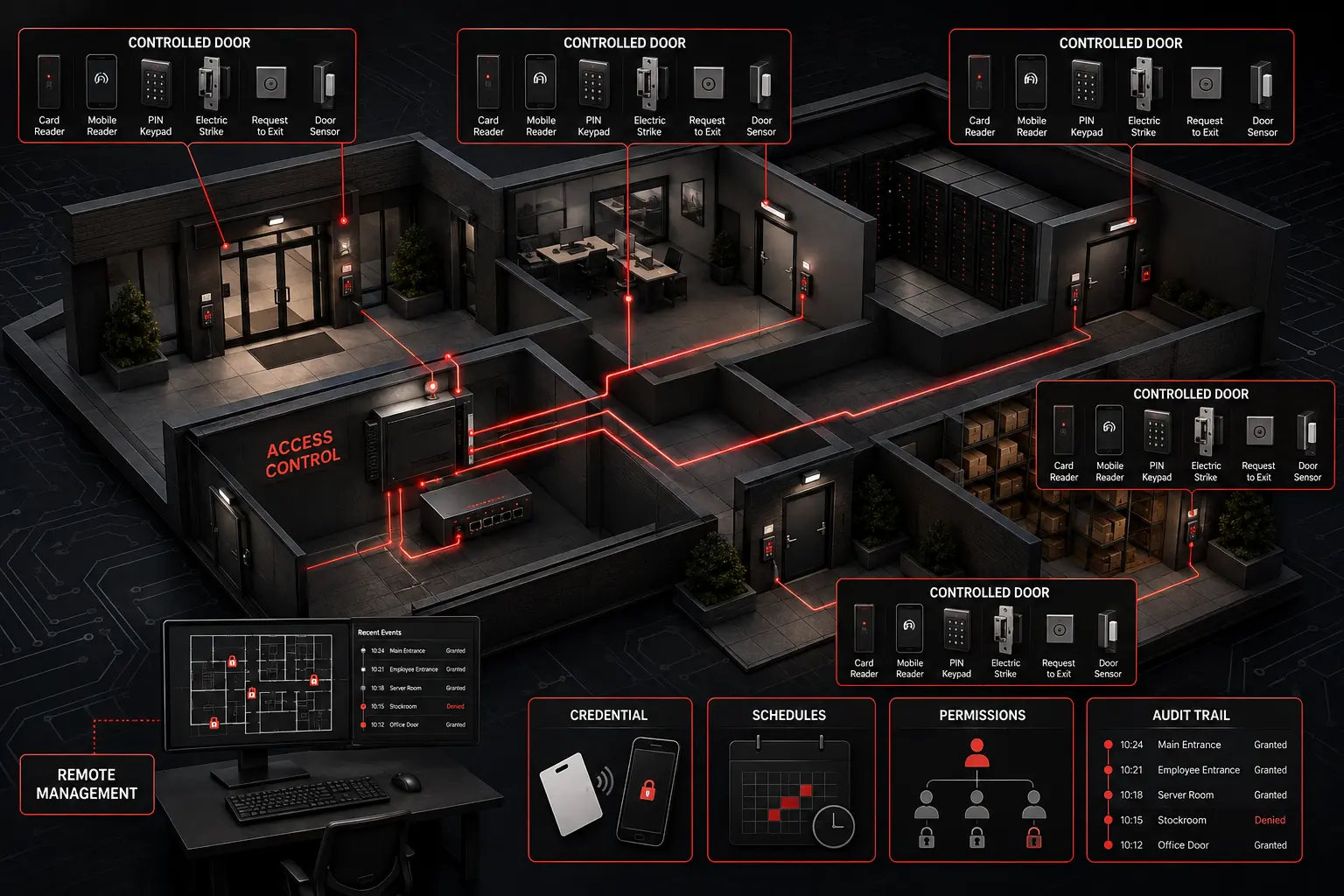
Kenmie designs commercial access-control systems that connect doors, credentials, schedules, events, and administration—so physical security is manageable from the entrance to the audit trail.
Every controlled opening becomes part of one manageable system.
Readers, credentials, locking hardware, controllers, schedules, permissions, and event history are designed as a connected whole.
Door hardware and credentials vary by facility.
Access is a system
More than a reader beside a door.
Effective access control depends on the complete path: the person, credential, reader, controller, locking hardware, network, policies, and event record. Kenmie plans those pieces around how your facility actually operates.
01
Controlled entry
Doors & Hardware
Bring readers, controllers, electric locking hardware, door-position monitoring, and request-to-exit devices together as one planned system.
Door-by-door design
Secure controller architecture
Held- and forced-door awareness
02
Identity at the door
Credentials
Give the right people the right access using cards, fobs, PINs, mobile credentials, or optional biometric methods selected for the environment.
Fast issue and revoke workflows
Individual accountability
Flexible credential choices
03
Central administration
Sites & Schedules
Manage people, doors, access groups, schedules, holidays, and multiple locations from a central administrative experience.
Role-based access groups
Time and holiday rules
Multi-site visibility
04
Operational awareness
Events & Audit Trails
Review granted and denied access, door conditions, alarms, and searchable activity history to answer what happened and when.
Searchable event records
Door and alarm status
Actionable notifications
A connected path
Every access decision becomes a useful record.
From the credential presented at the door to the event visible in administration, each component has a defined job.
01CredentialIdentifies the person
02ReaderReceives the request
03ControllerApplies the rules
04DoorUnlocks when authorized
05Event recordPreserves the outcome
Optional connections
Physical security works better with context.
Where the project calls for it, access control can share useful information with related security workflows without making daily administration complicated.
Video event context
When included in the design, access events can be paired with nearby camera coverage to make investigation faster and more useful.
Door conditions, auxiliary inputs, and event rules can support alerts and defined responses for important activity.
Temporary access
Time-limited credentials and visitor workflows can simplify access for contractors, guests, and short-term personnel.
Designed around the facility
From assessment through ongoing support.
Kenmie starts with who uses each opening, when they need access, how the door operates, and what must happen during normal and emergency conditions.
Site and door assessment
System and credential design
Cabling and hardware coordination
Configuration and enrollment
Testing, training, and support
Door systems must preserve required free egress and comply with applicable fire, building, accessibility, and life-safety requirements. Kenmie coordinates the access-control scope with the appropriate project professionals and authorities when needed.